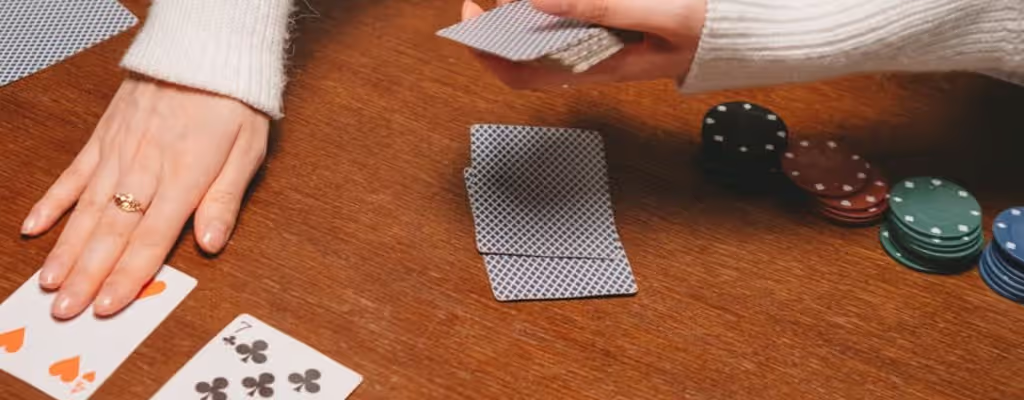
Solitaire Poker: A Surprisingly Strategic Solo Card Game
You’ve heard of solitaire. You’re familiar with poker. We’re here with solitaire poker, a surprisingly strategic solo card game for you to have fun.
Poker without other people sounds slightly wrong. Half the fun is supposed to be watching somebody confidently push chips forward while wondering if they are bluffing or simply have no idea what they are doing. Take the people away and surely you have just got cards on a table. Not quite.
Solitaire Poker takes poker hands and drops them into a solo puzzle. And somehow, it works ridiculously well. If you have ever opened solitaire free online expecting to waste five harmless minutes and resurfaced much later, you probably already understand the danger here.
So what are you actually doing?
There are different versions of Solitaire Poker, but a common setup uses a five by five grid. Cards arrive individually and you decide where each one goes. Once placed, they generally cannot be moved. Fill the grid and the rows and columns become poker hands. Pairs score. Straights score better. Flushes, full houses and the really pretty combinations are where the bigger points live. Simple enough.
Then you draw a nine. There is an eight sitting in one row, two diamonds developing elsewhere, and another nine that could become a pair. Suddenly this innocent little card has three possible homes and every one of them seems sensible. Pick one. Immediately question yourself. That is basically the game.
The grid changes everything
Knowing poker hands helps, obviously, but Solitaire Poker is not really about pretending you are at a casino table. There is nobody to bluff. Your sunglasses are useless. Instead, the interesting part is positioning. Every square belongs to both a row and a column, so one useful card can quietly work on two hands at once. That changes how you look at the board. A card that seems mediocre for one row might be exactly what the crossing column needs.
The temptation is to fall in love with one promising hand. Three hearts appear and suddenly you are emotionally committed to a flush. Bad idea. Sometimes the fourth heart never comes, while perfectly decent scoring opportunities elsewhere have been sacrificed in its honour. The better approach is usually less dramatic. Keep several possibilities alive. Take the boring pair when it makes sense. Leave yourself room to change direction.
And then luck ruins your clever plan
You can play sensibly and still get an awful sequence of cards. That is important because Solitaire Poker would probably lose its charm if every game could be solved through perfect calculation. You are working with incomplete information. The card you desperately want might be next. It might also be buried somewhere near the bottom of the deck, having a wonderful time while your straight falls apart. So the skill is not predicting exactly what comes next. It is building a grid that can survive several possibilities.
It gets better once you stop guessing
The first few rounds can feel like organised card dumping. Then something clicks. You start noticing which spaces are valuable. You stop blocking rows unnecessarily. You realise that a modest hand already taking shape can be worth protecting instead of constantly chasing something spectacular. That gradual improvement is probably why the game fits so naturally alongside free solitaire online games. It has the same relaxed solo setup, but there is more tinkering going on underneath.
A strangely clever little game
Solitaire Poker does not look particularly strategic at first glance. That is part of its charm. There are no complicated rules to study and no opponent trying to outsmart you. It is just a grid and a deck of cards. Then twenty minutes disappear because you are still annoyed about where you put that nine.
Related Articles