
Why Are There Four Suits? The Mysterious Origins of Playing Card Symbols
A modern playing card deck has 52 cards, four different suits, and usually a couple of Jokers. As to why the cards ended up this way, and why the suits and symbols are as they are, is a fascinating journey through history and cultural adaptations. Let's take a look.
Symbols of Medieval Society
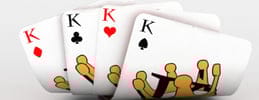
There is a historical belief that the four suits, spades, diamonds, hearts, and clubs are the four primary classes of Western medieval society. While not formally accepted as a historical fact, however, the belief is rooted in centuries of interpretation and symbolism.
Let's take a quick look at the four suits.
Spades are symbolic for the nobility or military on account of the spade looking like a sword. Spades suggest force and power as well as protection and governance.
Diamonds symbolize the merchants, commerce. The diamond represents money or wealth and the bearers were the rising economic force of the time.
Hearts represented the clergy and a connection to the chalice which is both a sacred and essential object used in religion. The relation to love and spirituality connects them to those responsible for guiding the flock.
Finally, clubs represent the working class, the peasants symbolic of the batons and staves. These are tools handled by the common laborers.
This medieval system of symbols is said to mirror a rigid society divided by functions and status depicted by the cards which is said to also be an allegorical teaching device to reinforce medieval social order.
Symbols across the lands
The use of playing cards has been said to originate from China or India in the 10th Century. As it spread through the Middle East, card symbols started to evolve and included symbols like cups, coins, polo sticks, and swords.
Eventually, the cards arrived in Southern Europe taking root in both Spain and Italy. The polo sticks which were unfamiliar to Western culture were then replaced by cudgels or batons. The four symbols together, Swords, Batons, Coins, and Cups became known as the "Latin Suits" and appear in Tarot Card decks and traditional Spanish and Italian card games till today.
When the cards reached Germany, German card makers modified the suits into Acorns, Leaves, Hearts, and Bells. Beautiful illustrated designs were also added but producing them was expensive as the cards had to be individually hand-painted.
Finally, the cards fell into the hands of the French who in the 15th Century, modified the cards in both form and function, Bells were transformed into Daimonds, Acorns into Clubs, Leaves into Spades, and Hearts, Hearts remained the same. Aside from this, the French introduced flat single-color suits which were easily stenciled onto the cards reducing production costs drastically and enabling mass production and wider access to them.
The cards then spread to England and eventually the Americas, thus becoming the playing card deck and online solitaire games that we currently have today. The French suits became standard as they were elegant, simple, and practical.
WildCard
In the American 1860s, card players who indulged in a game called "Euchre" discovered the need for a "trump card". Euchre is a trick-taking card game that uses a 24-card deck consisting of Kings, Queens, Jacks, 9s, 10s, and the Aces of each suit.
The most powerful cards were the "Bowers" known in German as "farmer" or "boy" and were represented by the Jacks. So, in 1863, Samuel Hart came up with the first version of this trump card known then as the "Imperial Bower" which eventually evolved into the "Imperial Jester" as the card was a "wild card" that added chaos and surprise to the game. The "Joker" was born.
As a wild card, the Joker could stand in for any other card. Think of a pawn reaching the innermost square on the enemy's side which can then be replaced by a Rook, Bishop, Knight, or Queen, but that's a totally different game. Anyway, that's what the Joker does, it brings a delightful unpredictability to the game. Symbolically, the card brings freedom from the rules, a multi-roled Jester of chaos.
The modern-day deck of cards in online solitaire games that we have today is a product of centuries of creativity, cultural exchange, and the evolution of society. From the nobility to the clergy, and the working class, and its continual historical evolution across the lands, from the French Suits to the added American Jester, all represent a long and winded history of storytelling and symbols printed onto a small piece of rectangular cardboard.
Related Articles